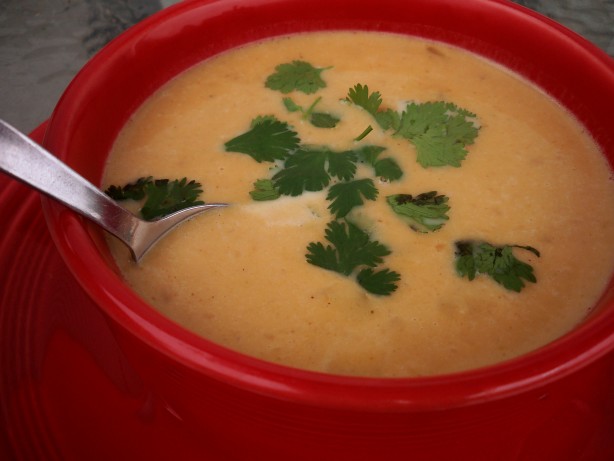
Try this Creamy Yam Soup recipe
- Carbohydrate 441.0757175 g
- Cholesterol 72 mg
- Fat 31.5466275 g
- Fiber 57.483723777771 g
- Protein 81.51516 g
- Saturated Fat 8.297775 g
- Serving Size 1 1 Serving (3878g)
- Sodium 3743.412 mg
- Sugar 383.591993722229 g
- Trans Fat 2.776571 g
- Calories 2374 calories
Step-by-step
- Bring stock or water to a boil.
- Add all ingredients.
- Boil until all veggies are soft, approximately 30 minutes.
- Let cool slightly, place in a blender or food processor, a batch at a time and blend until smooth.
- Return to pot, keep warm on low heat for 15 minutes.
The Mechanics of Softening Roots
Achieving a smooth consistency in root vegetable purees depends entirely on breaking down complex starches and pectin structures completely during the boiling phase. When yams, carrots, and celery submerge in five cups of boiling stock, heat penetrates cell walls to gelatinize starches and soften fibrous tissue. Boiling the mixture for approximately 30 minutes ensures that every piece yields instantly to the back of a spoon without resistance, which is necessary because undercooked vegetables will leave gritty particulates in the final emulsion rather than yielding a silky mouthfeel. Maintaining a rolling boil drives the heat transfer efficiently, though adjusting the burner down to a medium-low simmer once rolling prevents excessive evaporation.
Mastering the Blending Process
Pureeing hot liquids requires specific equipment handling to prevent pressure explosions and ensure uniform particle reduction. Transferring the cooked vegetables in batches to a blender or food processor allows the blades to shear fibrous strands into microscopic pieces, creating a natural thickening effect without adding heavy cream. Venting the blender lid slightly with a folded towel lets steam escape safely while processing. Working in smaller amounts prevents overloading the motor and guarantees that chunks of carrot or celery do not escape the blade vortex, resulting in a homogenous texture when returned to the pot for the final 15-minute warming phase.
Adjusting Yields and Proportions
Scaling this recipe requires maintaining precise ratios between dense root vegetables and the surrounding cooking liquid to avoid watery results. Doubling the batch demands a larger stockpot that can accommodate eight cups of yams alongside carrots and celery while ensuring adequate room for five to six cups of liquid to circulate freely. Measuring ingredients by volume rather than guesswork keeps the flavor profile balanced when modifying portion sizes for smaller or larger groups, particularly regarding potent spices like cinnamon and ground ginger.


